By RunToTrends Editorial Team | March 20, 2026
The Terrestrial Bottleneck: Power and Heat
Modern AI training clusters, such as those powered by NVIDIA’s Blackwell architecture, consume megawatts of electricity. A single “AI factory” can require as much power as a small city. On Earth, this leads to three primary constraints:
| Challenge | Terrestrial Reality | Orbital Advantage |
|---|---|---|
| Energy Source | Limited by grid capacity and fossil fuels. | Unfiltered, 24/7 solar energy (1.3 kW/m²). |
| Cooling | Requires massive amounts of water and HVAC. | Radiative cooling into the 3K vacuum of space. |
| Regulation | Subject to local zoning and environmental laws. | International waters/Space law flexibility. |
The Orbital Data Center Concept
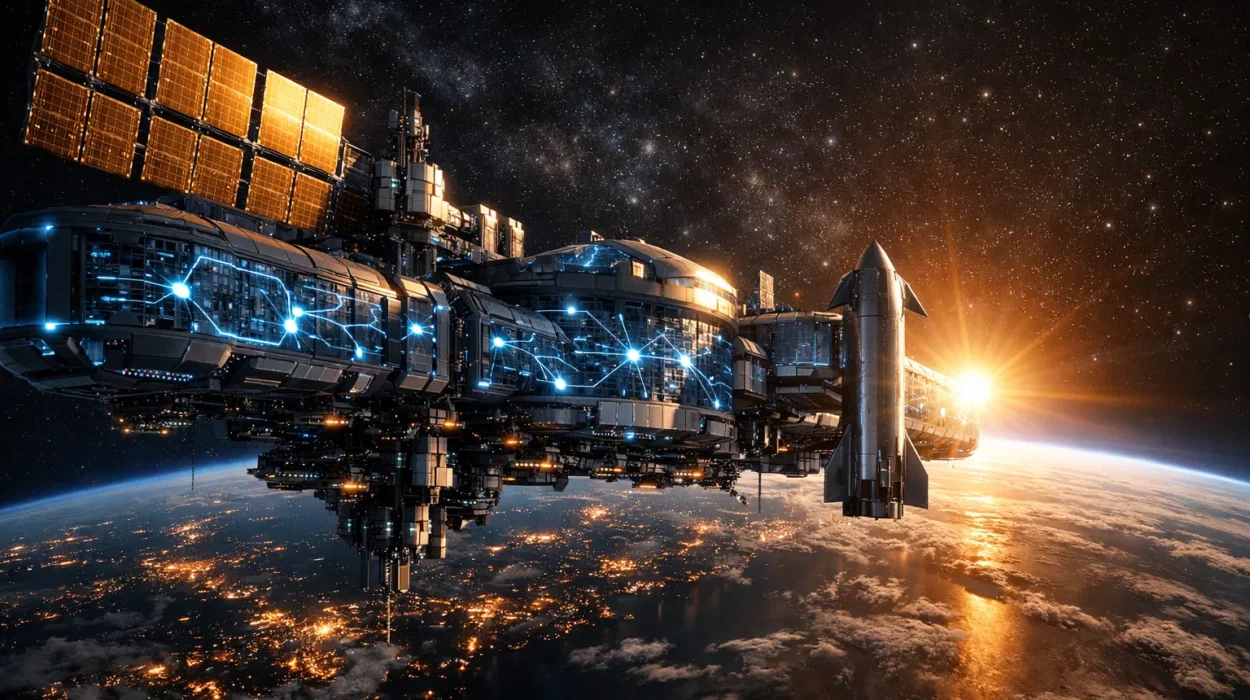
Musk’s vision involves launching modular, radiation-hardened data centers into Low Earth Orbit (LEO). These satellites would not just transmit data (like Starlink) but process it. By leveraging SpaceX’s Starship for low-cost heavy lifting, the cost per kilogram to orbit is plummeting, making orbital compute economically viable for the first time in history.
“If you want to build a terawatt-scale AI, you can’t do it on a planet with a biosphere. You have to go where the energy is infinite and the heat sink is absolute.” — Conceptual First Principles Analysis
Geopolitical Implications: The New High Ground
The shift to orbital AI isn’t just a technical move; it’s a geopolitical masterstroke. Sovereignty over data becomes complex when the servers are orbiting at 17,000 mph. For countries like the US and China, the “AI War” is expanding from chip fabs in Taiwan to launch pads in Texas and Hainan.
Conclusion: The Future is Up
As we approach the era of AGI, the infrastructure that supports it must evolve. Elon Musk’s orbital AI concept represents the ultimate synthesis of his two greatest ventures: SpaceX and xAI. For RunToTrends readers, the message is clear: The next tech gold rush isn’t happening on the ground—it’s happening in the stars.