For the past decade, the primary bottleneck for Artificial Intelligence was chip architecture. We needed faster GPUs, more HBM (High Bandwidth Memory), and lower latency interconnects. However, in his recent interview with Dwarkesh Patel, Elon Musk highlighted a paradigm shift. The new bottleneck isn’t the chip—it’s the transformer and the megawatt.
As we scale from Large Language Models (LLMs) to Large World Models (LWMs) and eventually Artificial General Intelligence (AGI), the power requirements are becoming unsustainable for traditional terrestrial grids.
“We are moving from a world where chips were the bottleneck to a world where transformers and electricity are the bottleneck,” Musk explained. “The amount of electricity required to train and run these massive models is starting to rival the consumption of entire nations.”
The Terawatt Challenge
Current state-of-the-art data centers consume hundreds of megawatts. Future clusters, aimed at training models with trillions of parameters, will require terawatts. Building such infrastructure on Earth poses three massive challenges:
1.Grid Instability: Existing power grids are aging and cannot handle the sudden, massive surges required by AI clusters.
2.Environmental Impact: Cooling these clusters requires billions of gallons of water, and powering them with fossil fuels negates the “green AI” promise.
3.Political Regulation: Governments are increasingly regulating data center power consumption to protect residential and industrial energy security.
II. Why Space? The Orbital Solar Advantage
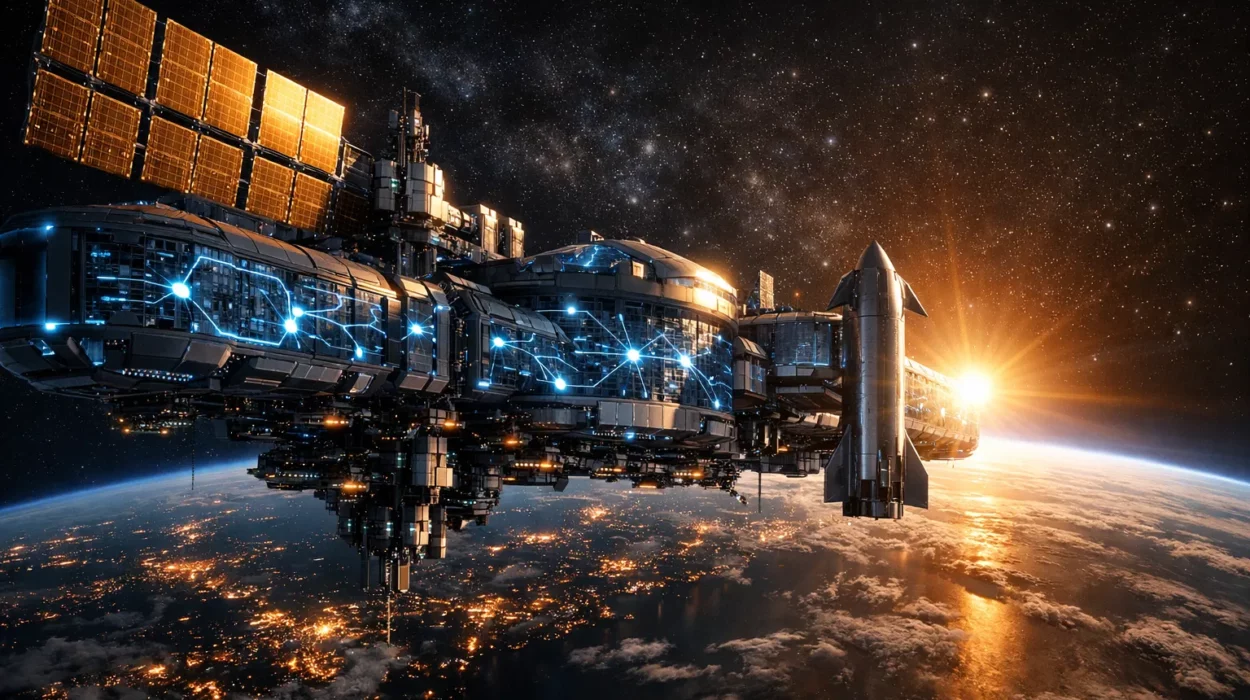
Musk’s proposal to move AI compute into orbit isn’t just “cool tech”—it’s a fundamental optimization of physics. In space, the laws of energy generation change in favor of high-performance computing.
1. The 5x Solar Multiplier
On Earth, solar panels are limited by the atmosphere, weather, and the 24-hour day-night cycle. In a sun-synchronous orbit, solar panels can achieve 99% uptime. Furthermore, without atmospheric interference, solar intensity is roughly 1,361 watts per square meter.
•Terrestrial Solar Efficiency: ~15-20% effective uptime.
•Orbital Solar Efficiency: ~95-99% effective uptime.
This results in a 5x increase in energy yield per square meter of solar array compared to the best terrestrial locations like the Sahara Desert.
2. Radiative Cooling in a Vacuum
One of the biggest misconceptions about space-based computing is that it’s impossible to cool. While it’s true that space is a vacuum (no air for convection), it is an incredible environment for radiative cooling. By using large-scale liquid-metal radiators, data centers can shed heat directly into the cosmic background radiation (approx. 3 Kelvin). This eliminates the need for water-based cooling towers entirely.
III. The Starship Catalyst: 10,000 Launches per Year
The “Orbital AI” vision remains a fantasy without a radical reduction in launch costs. This is where SpaceX’s Starship enters the frame. Musk isn’t just aiming for a few launches a month; he is building a logistical pipeline for 10,000 launches per year.
The Economics of Orbital Mass
|
Metric
|
Current Falcon 9
|
Future Starship (Target)
|
|
Payload to LEO
|
~22.8 Tons
|
~100-150+ Tons (Fully Reusable)
|
|
Cost per Launch
|
~$67 Million
|
<$10 Million (Fuel & Ops only)
|
|
Cost per kg to Orbit
|
~$3,000
|
<$100
|
With a cost of $100 per kg, launching a massive GPU cluster becomes economically competitive with building a massive terrestrial facility that requires land acquisition, complex permits, and grid upgrades. 10,000 launches a year would allow SpaceX to put over 1 million tons of hardware into orbit annually—enough to build a “Dyson Swarm” of intelligence.
IV. The Geopolitical “Orbital Brain” Race
If intelligence is the most valuable commodity of the 21st century, then the location of that intelligence matters. An AI cluster in orbit is essentially a sovereign entity. It operates outside the immediate physical jurisdiction of terrestrial nations, governed by the entity that controls the launch and communication infrastructure.
US vs. China: The High Ground
The United States currently holds a lead in both AI (OpenAI, Anthropic, Google) and space (SpaceX). However, China is rapidly developing its own reusable heavy-lift rockets and massive AI models.
•The US Strategy: Leveraging private-sector innovation (SpaceX/Starlink) to dominate the orbital “High Ground.”
•The China Strategy: State-backed “G60 Starlink” equivalent and rapid scaling of domestic GPU manufacturing.
The winner of this race won’t just control the internet; they will control the global inference engine.
V. Challenges and Risks: The “Kessler Syndrome” for AI
Moving AI to space isn’t without significant risks:
1.Latency: Even at the speed of light, the round-trip time from Earth to LEO (Low Earth Orbit) and back adds milliseconds. While acceptable for training, it may pose challenges for real-time edge inference.
2.Space Debris: A collision in a crowded orbit could trigger a chain reaction (Kessler Syndrome), destroying billions of dollars in GPU hardware.
3.Radiation: Cosmic rays can cause “bit flips” in GPU memory. High-orbit data centers will require advanced radiation shielding and error-correcting code (ECC) memory at an unprecedented scale.
VI. Conclusion: The Dawn of Multi-Planetary Intelligence
Elon Musk’s vision for Orbital AI is the logical conclusion of the “First Principles” thinking that built Tesla and SpaceX. If Earth is too small and too energy-constrained for the intelligence we wish to create, we must look to the stars.
As Starship becomes operational and the “Hardware Wall” on Earth becomes insurmountable, we may soon see the first Orbital GPU Clusters lighting up the night sky—not as stars, but as the thinking machines that will guide humanity into the next century.