
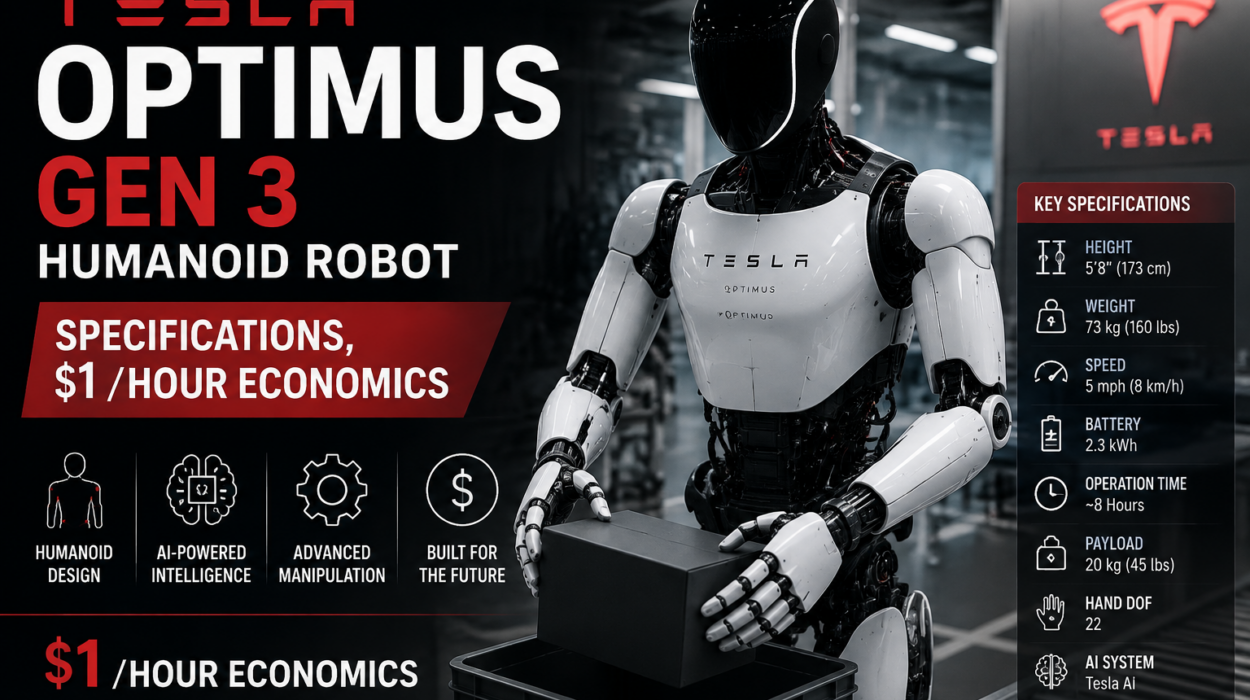
The robotics industry stands on the precipice of a radical evolution. For decades, industrial robots were isolated, heavy, single-purpose machines bolted to factory floors—capable of high speed and power, yet entirely void of adaptability. Today, the convergence of advanced physical artificial intelligence, high-density energy storage, and biomimetic mechanical engineering is rewriting that narrative. Leading this historic transformation is the Tesla Optimus Gen 3 humanoid robot, a platform designed not merely to assist in controlled manufacturing environments, but to integrate seamlessly into human homes, offices, and complex industrial spaces.
While rival robotics platforms from various international manufacturers have frequently demonstrated remarkable agility—performing backflips, running, or executing synchronized choreography—their practical utility in real-world environments remains heavily limited. A humanoid robot that can perform kung fu for a promotional video but cannot wash a dish, handle an egg, or assemble a battery cell offers little long-term economic value.
Tesla’s engineering philosophy with the Tesla Optimus Gen 3 humanoid robot shifts the focus entirely toward economic utility and physical capability. Designed to undertake dangerous, repetitive, or undesirable labor, the Gen 3 model represents Tesla’s evolution from an electric vehicle manufacturer into the world’s premier physical AI and robotics enterprise.
With promised hardware improvements—including biomimetic 22-degree-of-freedom hands, the ultra-advanced AI5 processing silicon, Grok natural language AI integration, and a disruptive $1-per-hour operational cost model—Optimus Gen 3 is poised to redefine global labor economics forever.
Hardware Innovations: Dexterity and Biomimetic Engineering
The fundamental challenge in building a general-purpose humanoid robot is not enabling it to walk; it is enabling it to manipulate physical objects with human-like delicacy and power. Human hands possess an extraordinary density of joints, tendons, and sensory nerves, allowing us to alternate effortlessly between cracking an egg and wielding heavy tools.
The Tesla Optimus Gen 3 humanoid robot addresses this challenge through a ground-up mechanical redesign of its end-effectors.
                     +---------------------------------------+
                     |         FOREARM (Actuators)           |
                     |  - High-Torque Motors                 |
                     |  - Reduced Mass in Hand               |
                     +-------------------+-------------------+
                                         |
                                         | (Tendon-like Cables)
                                         v
                     +---------------------------------------+
                     |          WRIST & FINGERS              |
                     |  - 22 Degrees of Freedom (DoF)       |
                     |  - Tactile & Force Sensors            |
                     |  - Water-Resistant Design             |
                     +---------------------------------------+
1. 22 Degrees of Freedom (DoF) Hand Architecture
Previous iterations of the Tesla Bot featured 11 degrees of freedom per hand, which, while capable, restricted fine motor tasks. The Tesla Optimus Gen 3 humanoid robot doubles this capacity to 22 degrees of freedom per hand. This expansion allows the fingers to articulate with near-human flexibility, opening up thousands of fine motor capabilities, from opening bottle caps and folding laundry to operating intricate power tools.
2. Forearm-Mounted Actuators and Tendon Mechanics
Fitting heavy electric motors directly inside a robot’s palm creates excess weight, reduces precision, and severely restricts thermal dissipation. To solve this, Tesla engineers adopted a biomimetic approach modeled after human biology.
Most of the hand’s primary actuators are located in the robot’s forearm. Force is transmitted down through the wrist to individual finger joints via high-tensile, tendon-like synthetic cables. This relocates weight closer to the center of movement, creating a lighter, more agile hand capable of lifting heavy objects up to 18 kg (40 lbs) while retaining sub-millimeter precision.
3. Integrated Tactile Sensing and Environmental Resistance
Each finger of the Gen 3 hand features nearly triple the density of force and tactile sensors compared to earlier builds. These sensors feed real-time feedback into the control unit, allowing the robot to feel textures, judge object elasticity, and automatically adjust grip force.
Furthermore, leak reports and engineering images suggest the inclusion of water resistance across the hands and forearms, allowing the robot to wash dishes, handle wet items, and clean domestic environments without short-circuiting.
Intelligence Architecture: AI5 Silicon and Grok Integration
Hardware is only as capable as the intelligence driving it. While standard autonomous systems process visual data to navigate roads, a humanoid robot must master both visual intelligence and physical intelligence simultaneously.
+-----------------------------------------------------------------------+
|                       TESLA OPTIMUS GEN 3 BRAIN                       |
+-----------------------------------+-----------------------------------+
                                    |
            +-----------------------+-----------------------+
            |                                               |
            v                                               v
+-----------------------+                       +-----------------------+
|       AI5 CHIP        |                       |   GROK VOICE & LLM    |
| - High Memory Bandwidth|                      | - Natural Commands    |
| - Real-Time Vision    |                       | - Interactive Reasoning|
| - Tactile Force Loops |                       | - Task Adaptation     |
+-----------------------+                       +-----------------------+
The AI5 Processing Platform
At the core of the Tesla Optimus Gen 3 humanoid robot is Tesla’s next-generation AI5 processor. Designed specifically for high-throughput neural network evaluation, the AI5 chip offers significantly higher memory bandwidth and compute performance compared to the AI4 chip found in current Tesla vehicles.
Physical manipulation requires continuous, real-time calculations: processing multiple high-resolution video streams, evaluating tactile pressure, balancing spatial telemetry, and predicting path collisions—all with minimal latency. The AI5 silicon provides the necessary local computational power to execute these tasks locally without relying on high-latency cloud connections.
Grok Natural Language and Interactive AI
The integration of xAI’s Grok engine transforms how users interact with the robot. Rather than requiring rigid voice commands or pre-coded scripts, users can speak to the Gen 3 bot naturally.
-
User Input: “Optimus, please clear the dining table and put the leftovers in the fridge.”
-
Robot Inference: The robot identifies the tableware, assesses the temperature and state of food items, opens the refrigerator, places items safely inside, and wipes down the table surface—asking clarifying questions if it encounters an unknown object.
Autonomous Video Learning & Fleet Neural Sharing
One of the most revolutionary aspects of the software stack powering the Tesla Optimus Gen 3 humanoid robot is its ability to learn through demonstration. The robot can analyze video tutorials—such as YouTube guides on cooking or machine repair—and map those movements to its own physical kinematics.
More importantly, Tesla utilizes a shared fleet neural network. When a single Optimus robot in a Tesla factory masters a new task (e.g., picking up a complex wire harness), that experience is processed, converted into updated neural weights, and pushed over-the-air to every Optimus unit across the global fleet.
Disruption in Labor Economics: The $1/Hour Calculation
The true market viability of any general-purpose robot hinges on its total cost of ownership versus human labor costs. Elon Musk’s claim that the Tesla Optimus Gen 3 humanoid robot can eventually operate for as little as $1 per hour seems impossible at first glance, but a detailed breakdown of the unit economics reveals the mathematical foundation behind this projection.
Economic Breakdown Model ($30,000 Target Price)
Assuming Tesla achieves its long-term target price of $30,000 per unit at mass scale, consider the following operational model:
| Cost Category | Projection Metric | Cost Contribution |
| Capital Amortization | $30,000 over 10-Year Lifespan (70,000 working hours) | $0.43 / Hour |
| Energy Consumption | ~3 kWh Battery (~0.6 kWh/hr usage @ $0.15/kWh) | $0.09 / Hour |
| Maintenance & Overhaul | Replacement actuators, joints, soft covers, and wear items | $0.30 / Hour |
| Connectivity & Cloud | Cellular 5G data, software updates, enterprise support | $0.18 / Hour |
| Total Operational Cost | Comprehensive Per-Hour Cost | ~$1.00 / Hour |
    [ $0.43 Hardware Amortization ]
  + [ $0.09 Energy Cost           ]
  + [ $0.30 Maintenance & Parts   ]
  + [ $0.18 Network & Software    ]
  ---------------------------------
  = $1.00 Total Cost Per Hour
Comparative Analysis: Human Labor vs. Humanoid Automation
To understand the economic impact, compare the operational expenses of traditional human labor against a fleet of Gen 3 robots working in industrial or domestic environments:
| Parameter | Human Worker (Factory / Logistics) | Tesla Optimus Gen 3 Fleet |
| Average Hourly Cost | $18.00 – $35.00 / hour (plus benefits) | ~$1.00 / hour (long-term target) |
| Daily Operational Availability | 8 Hours / Shift (Requires breaks/rest) | 20–24 Hours / Day (Tethered or auto-docking) |
| Annual Productive Hours | ~2,000 Hours / Year | 7,000+ Hours / Year |
| Training & Onboarding | Weeks/Months per new task | Instantaneous via software/fleet update |
| Workplace Injury Risk | High (Repetitive strain, heavy lifting) | Zero human physical strain |
Manufacturing, Supply Chain, and Deployment Strategy
Building a prototype humanoid robot is relatively easy; mass-manufacturing millions of units with extreme precision and low scrap rates is extraordinarily difficult. Tesla’s rollout strategy for the Tesla Optimus Gen 3 humanoid robot follows a structured three-phase roadmap.
+-------------------------------------------------------------------+
|                     THREE-PHASE DEPLOYMENT ROADMAP                |
+-------------------------------------------------------------------+
| Phase 1: Internal Factory Testing (Fremont & Giga Texas)          |
|  - Real-world telemetry gathering                                 |
|  - Battery cell & parts handling                                  |
+-------------------------------------------------------------------+
                                  |
                                  v
+-------------------------------------------------------------------+
| Phase 2: B2B Industrial & Commercial Sales                        |
|  - Warehousing, logistics, and structured assembly                |
|  - Price range: $50,000 - $100,000 initial units                  |
+-------------------------------------------------------------------+
                                  |
                                  v
+-------------------------------------------------------------------+
| Phase 3: Consumer / Mass Domestic Availability                    |
|  - Cooking, cleaning, eldercare, and household chores             |
|  - Scaled price target: $20,000 - $30,000                          |
+-------------------------------------------------------------------+
Phase 1: In-House Factory Validation
Before selling a single unit to the public, Tesla deploys thousands of Gen 3 bots inside its own manufacturing plants, such as the Fremont Factory and Gigafactory Texas. Here, the robots perform real tasks: moving heavy stampings, sorting logistics trays, and loading battery cells into pack structures.
This controlled environment acts as an incubator. Every error, dropped part, or joint wear metric is analyzed to refine the hardware before public release.
Phase 2: Overcoming the Custom Supply Chain
A major hurdle facing humanoid robotics is the lack of off-the-shelf components. Standard industrial motors, gearboxes, and actuators are far too heavy, bulky, or inefficient for a 57 kg (125 lb) robot.
Tesla has had to design and build an entire supply chain from scratch, including custom planetary gearboxes, frameless BLDC motors, custom load cells, and specialized harmonic drives. Production capacity is being scaled toward a target of up to 10 million units per year at dedicated facilities.
Phase 3: B2B and Consumer Market Entry
Initial commercial sales will target enterprise clients in warehousing, heavy manufacturing, and retail logistics, where units may initially sell for $50,000 or more. As economies of scale reduce component costs, Tesla aims to push the retail price down into the $20,000–$30,000 range, opening up the mass consumer market for domestic assistance.
Safety, Ethical Implications, and Future Outlook
Deploying high-torque, 125-pound metallic humanoid robots alongside human beings introduces significant safety and social considerations.
Physical Safety Protocols
Unlike soft-software virtual assistants, a physical robot moving incorrectly can cause real harm. The Tesla Optimus Gen 3 humanoid robot addresses safety through multiple redundant layers:
-
Force-Limiting Actuators: If a joint encounters unexpected resistance (such as touching a human arm), force sensors trigger an instantaneous physical stop.
-
Visual Bubble Mapping: Dual 8MP vision cameras maintain a constant 360-degree real-time proximity map, ensuring the robot slows down when humans enter its immediate workspace.
-
Soft Foreign Sheathing: Key impact areas, such as chest plates and forearm fore-edges, utilize shock-absorbing materials to minimize collision impact risks.
Social and Labor Market Realities
The widespread adoption of a $1/hour robotic labor force will inevitably disrupt traditional employment structures. Low-skill, repetitive physical roles in manufacturing and logistics will face rapid automation.
However, history shows that automation typically shifts human labor toward higher-value roles: robot fleet management, maintenance engineering, software development, and personalized human care services.
Also Read: Build Your Own Home Cloud: DIY Raspberry Pi Storage Guide
Conclusion: A Paradigm Shift in Human History
The Tesla Optimus Gen 3 humanoid robot is far more than an impressive engineering project or a viral tech demonstration. It represents the vanguard of a fundamental transformation in how human society produces goods, manages logistics, and handles daily domestic life.
By combining human-like physical flexibility (22-DoF biomimetic hands), state-of-the-art physical AI (AI5 chip and Grok integration), and unprecedented production economics ($1/hour projected operating costs), Tesla is laying the groundwork for a post-scarcity labor economy.
While challenges in supply chain scaling and software edge-cases remain, the transition from special-purpose industrial automation to general-purpose humanoid companions is no longer a matter of if—it is a matter of when.